
Shoulder Replacement
Information published by IRCOS about Shoulder Replacement: relevant practitioners, available content and related documents to help you prepare for your consultation.
A prosthesis is an element whose role is to replace an organ in the body.
There are many prostheses:
– The best known are joint prostheses: they replace the cartilaginous, bony and sometimes ligamentous elements of a joint. The best known are hip and knee prostheses; But we also manufacture shoulder, ankle, wrist, elbow, finger joint, intervertebral disc prostheses, etc. Very few joints in the body do not yet have corresponding prostheses.
– Other prostheses are also known: heart valve prostheses, for example.
– Certain prostheses are less known or less often used: ligament prostheses (or artificial ligaments), vessel prostheses (aorta for example).
When to put in a prosthesis?
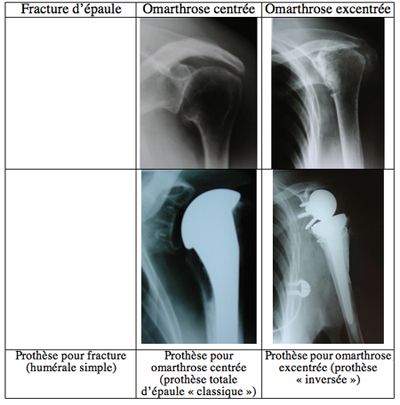
There are three main circumstances in which a shoulder prosthesis is necessary:
– Certain complex fractures (link to shoulder fracture)
– Shoulder osteoarthritis without rotator cuff tear, also called centric osteoarthritis (link to osteoarthritis)
– Shoulder osteoarthritis with rotator cuff tear, called eccentric osteoarthritis
What is a prosthesis made of?
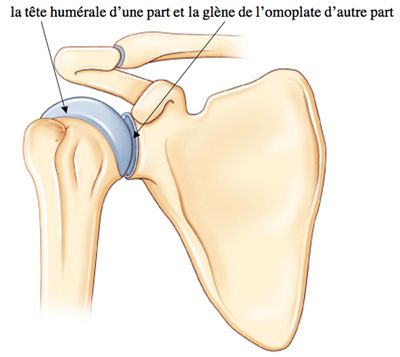
Depending on the joint it replaces, a prosthesis is made up of several different elements.
At the shoulder level, the principle is to replace the humeral head on the one hand and the glenoid of the scapula on the other hand.
The elements that constitute a prosthesis can be:
– Metal: steel alloy, titanium alloy, zirconium alloy.
– Made of very high density polyethylene: a type of ultra-resistant plastic adapted to the human body.
Fitting the prosthesis
– The patient is in a semi-sitting position.
– Anesthesia (link to this term) is most often general, in association with local shoulder anesthesia, via a catheter left in place after the operation. This additional local anesthesia makes it possible to significantly reduce post-operative pain, upon awakening from general anesthesia.
– The intervention lasts from 1 hour to 3 hours depending on its complexity.
Postoperative immobilization
– In almost all cases, a removable splint is put in place at the end of the operation and must be kept on for between 3 and 6 weeks depending on the type of operation and the surgeon's habits.
– Rehabilitation depends on the type of intervention. During the first 4 to 6 weeks, it often consists of simple passive mobilization of the shoulder by the physiotherapist.
Authorized gestures
– Once the healing of the muscles has been achieved, generally between 1 month and 1/2 to 2 months after the operation, active mobilization by the patient himself is stimulated by the physiotherapist.
– It takes between 3 and 6 months of rehabilitation to obtain a supple, mobile and pain-free shoulder in the vast majority of cases.
Complications
– Complications of anesthesia are not specific.
– Infection is a rare complication (approximately 1%) but is the most dangerous. It is impossible with the current state of scientific knowledge to reduce the risk of infection to 0%. This risk does not only depend on the surgeon, the surgical technique used, or post-operative care. It also depends to a very large extent on parameters that the surgeon, the anesthetist and the healthcare team cannot control, whatever the efforts and quality of the care. Examples of infectious risk linked to patients are numerous and vary greatly from one patient to another: diabetes, immune disease, AIDS, active infection in another part of the body (urinary infection for example), general condition of the patient, age, state of cleanliness of the patient himself, etc.
An infection generally requires changing the prosthesis, most often in two stages: prosthetic removal time, prosthetic rest time. These two stages are interspersed with a long period of intravenous and then oral antibiotic therapy.
Regardless, in order to reduce the risk of infection, numerous precautions will be taken by the surgeon and the healthcare team before, during and after the procedure.
– Fractures: they can occur during the intervention and are then immediately treated: the consequence may be a slowdown in the pace of rehabilitation.
They can occur after the intervention, even several years later. Their management absolutely requires specialist advice, most often a return to the surgeon who installed the prosthesis.
– Dislocation of the prosthesis: rare, but annoying, because it most often requires reoperation for stabilization.
– Muscle ruptures, particularly of the subscapularis muscle. They are especially common in cases of dislocation or technical defect in the intraoperative repair of the muscle.
– Wear of the prosthesis: this is not really a complication, since any prosthesis placed in the body wears out, like an automobile part. The speed of wear depends on the patient, the type of prosthesis, the use made of the prosthesis, the quality of installation, etc. It most often occurs after more than 10 years of operation of the prosthesis and is not always painful. Only the appearance of pain can lead to changing the worn prosthesis.
What function to expect?
The final result obtained depends on several elements:
The type of pathology requiring the installation of a prosthesis: – fractures always give worse results on mobility than osteoarthritis, even if the results on pain are excellent
– Reversed prostheses often give spectacular results in patients who barely move the shoulder.
The age of the patients: young subjects rehabilitate more quickly and have muscular and tendon quality allowing a better result
Installation technique: only surgeons who have some experience with shoulder prostheses have the experience to cope with all situations, even the most difficult.
A shoulder prosthesis placed in good conditions, correctly rehabilitated, without damage linked to a fracture or disappearance of the rotator cuff tendons allows normal function of the shoulder to be regained.
How long does a shoulder prosthesis last?
More than 90% of shoulder prostheses installed function without problems for more than 15 years