Ligament Pathology
Information published by IRCOS about Ligament Pathology: relevant practitioners, available content and related documents to help you prepare for your consultation.
The stability of the knee, essential for its proper functioning, is ensured by the ligaments…
Anatomy
The knee is made up of three bones: the femur, the tibia and the patella. The stability of the knee, essential for its proper functioning, is ensured by:
– the lateral ligaments located on either side of the knee
– the cruciate ligaments, anterior and posterior, located in the middle of the knee and constituting what is called the central pivot
The main role of the Anterior Cruciate Ligament is to fight against the anterior drawer, that is to say the anterior translation of the tibia under the femur
ACL rupture: Consequences
Serious knee sprains with rupture of the Anterior Cruciate Ligament most often occur during sports trauma. It is “by twisting the knee”, that is to say by indirect trauma to the knee, that we rupture the Ligament.
Most often patients feel a giving way in the knee, severe pain, and have a bad knee.
The clinical examination is most often sufficient to make the diagnosis. MRI is an essential complement to confirm the diagnosis, and especially to carry out a complete assessment of the knee, looking in particular for associated meniscal lesions.
The absence of the anterior cruciate ligament exposes the patient to several risks:
– the occurrence of instability accidents, i.e. knee collapse followed by pain and effusions. The occurrence of these accidents prevents the practice of sport, particularly pivotal sports such as football.
– in the long term, the knee will deteriorate, and it is currently scientifically proven that ACL rupture causes osteoarthritis.
Ligament surgery
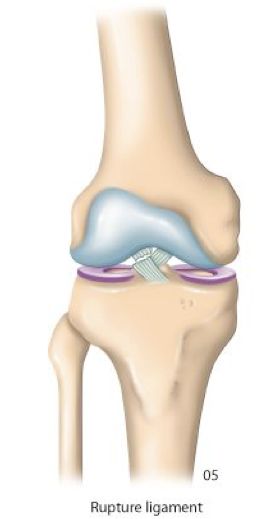
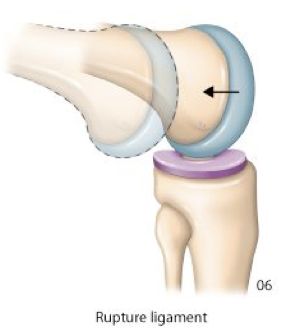
The decision for an intervention is made on a case-by-case basis, based on numerous criteria: age, sporting and professional activities, associated injuries, etc.
Suturing a cruciate ligament is ineffective because, once ruptured, the ligament cannot heal. The torn ACL must therefore be replaced: this is called ligamentoplasty.
Artificial ligaments have always failed until now, and are therefore no longer used.
We use a tendon autograft, that is to say we take a tendon which will replace the ruptured ligament. Basically there are two different techniques:
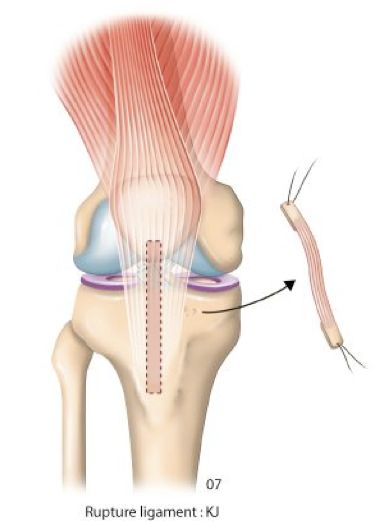
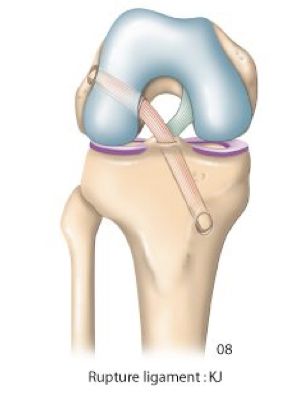
–the patellar tendon technique (Kenneth Jones)
It is part of the patellar tendon that will be removed (around 1/3) and which will allow the ACL to be replaced. Through a short incision which runs from the tip of the patella to the top of the tibial tuberosity, one third of the patellar tendon with its bony attachments is removed. The rest of the intervention takes place under arthroscopy: a camera is introduced into the joint which will allow a complete assessment (menisci and cartilages) to be carried out. The remnants of the injured ACL are removed, then the tendon transplant is placed in exactly the same place as the old ligament. It is fixed by bio-resorbable systems, that is to say non-metallic.
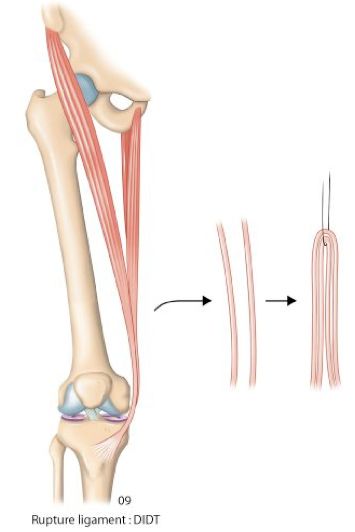
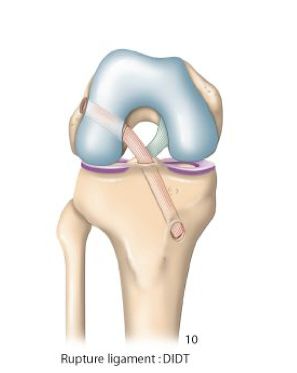
–the hamstring tendon technique (DIDT)The tendons taken are the tendons of the internal rectus and semitendinosus muscles. To do this, a short incision is made on the inner part of the tibia. The rest of the procedure is identical to that previously described.
Rehabilitation after knee ligamentoplasty
A) Warning:
Any surgical operation is not decided “lightly”; knee ligamentoplasty in particular.
Aware of the risks inherent in surgery and anesthesia, the result of a ligamentoplasty will depend on “your psychological state” in view of this procedure, on your ability to invest time in post-surgical rehabilitation.
Clearly, do not decide on ligamentoplasty if for any reason you are anxious, stressed, “depressed” and/or you will not be able to devote between six to eight months to post-operative rehabilitation. You risk, in fact, despite a perfect surgical procedure, causing joint and tissue problems that may be irreversible.
The decision to have a ligamentoplasty will therefore be the result of a discussion with your orthopedic surgeon and your trauma or rehabilitation sports doctor who will follow you throughout your “rehabilitation marathon”
B) Objective of rehabilitation:
Recover a knee as “performing” as before the operation.
C) Rehabilitation:
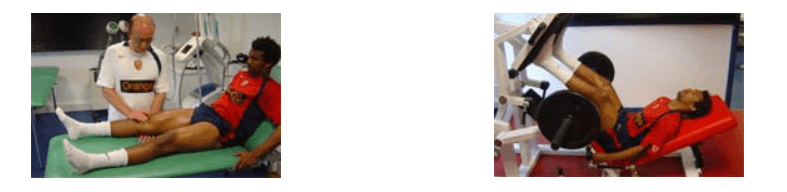
1) the first 2 months: recover normal walking
– quickly eliminate swelling and inflammation of the knee
– walks under cover of English canes and a removable splint
– rapid recovery of extension and flexion to 90°
– relaxation, muscular awakening of the quadriceps through isometric contractions
– closed chain knee lock work
– press work 0°-20° flexion
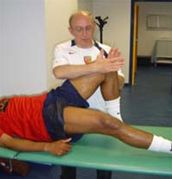
2)3rd month: period of fragility “of the new anterior cruciate ligament”. Symmetrical use of your knee.
If the knee allows it (no more inflammation), possible resumption of professional activity depending on the physical constraints imposed by it.
We will look for perfect symmetry of movement when walking, running on stabilized and flat ground, cycling and swimming (crawl only).
Given the fragility of the "neo-ligament", bodybuilding, strictly speaking, of the quadriceps in the leg (sitting on a chair and lifting loads) is prohibited. Only isometric and dynamic techniques called closed chains will be performed.
Likewise, so-called proprioception exercises (work to control and correct unstable positions of a joint in space) should preferably be carried out lying down or sitting.
3)from the 4th month: sufficient strength of the neo-ligament, priority for muscle strengthening.
– measurement of the muscle strength deficit of the quadriceps on the operated side compared to that on the “healthy” side using the Cybex test
– muscle strengthening until the deficit is filled
– intensification of running, swimming, cycling, axial sports to improve physical fitness.
Warning: poor physical fitness, as well as compensation for the work of the operated knee on the healthy knee, can have the “tragic” consequence of a rupture of the anterior cruciate ligament on the healthy side or even a rupture of the neo-ligament.
– proprioception (instability board, tampoline, etc.)