
Shoulder Fracture
Information published by IRCOS about Shoulder Fracture: relevant practitioners, available content and related documents to help you prepare for your consultation.
Why do we fracture our shoulders?
Shoulder fractures, particularly fractures of the upper end of the humerus, are common fractures, particularly in women over the age of 50.
They are in fact linked to a phenomenon of bone impoverishment called osteoporosis. Osteoporosis is often responsible for other fractures (wrist, femoral neck, ankle, vertebral compression) and preferentially affects women after menopause.
The phenomenon, associated with a fall on the shoulder most often, rarely on the hand, can be the cause of a fracture of the upper end of the humerus.
More rarely, fractures occur in the context of violent trauma (sports accident, public road accident), so they more often affect young men.
Clinical signs
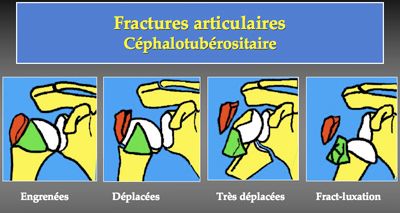
The pain is intense, it is impossible to raise the arm or even move it away from the body.
A hematoma can sometimes appear secondarily in front of the shoulder and spread to the arm and even to the thorax. It is not serious when it appears within 12 to 24 hours and spreads slowly without any other clinical sign: it only reflects the bleeding linked to the bone fracture.
Very rarely, but your surgeon will always look for it, the fracture can compress a nerve of the upper limb or an artery and lead to paralysis or a lack of blood supply to the upper limb: hospitalization and emergency treatment are then necessary.
What treatment?
SIMPLE FRACTURES
These fractures are often simple (2 fragments), barely displaced and treated with a large elbow-to-body bandage called Dujarier bandage, which is kept on for 3 to 5 weeks, depending on the age and severity of the fracture.
X-rays with consultation from your surgeon are necessary at regular intervals in order to detect a displacement of the fracture which could then require another type of treatment.
Once immobilization is complete, rehabilitation is essential and must be prolonged, often 3 to 6 months, before being able to recover a functional and pain-free shoulder.
In simple fractures, there are often no after-effects and function is recovered without difficulty.
COMPLEX FRACTURES
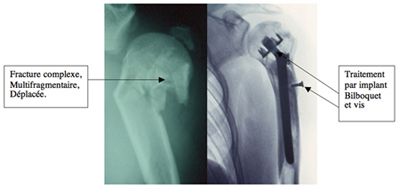
Sometimes, the fractures are more complex (3 fragments or more) and/or are very displaced and may then require surgical treatment.
This treatment varies from one fracture to another and depends greatly on the complexity and displacement of the fracture and the age of the patient.
The more complex the fracture, the more difficult it is to analyze it on simple x-rays. Your surgeon will then prescribe a CT scan which will allow him to better analyze the number of fragments and the movement of each fragment in order to choose the best treatment for each type of fracture.
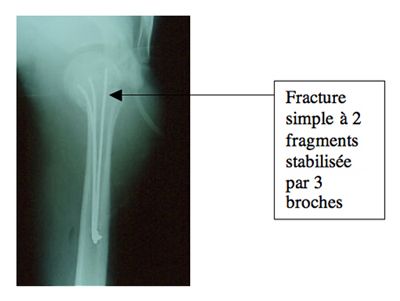
What surgical treatments can be used?
1° BROKES: Simple and quick treatment, they are reserved for displaced fractures in young patients (generally under 50 years old). They require additional immobilization, which is well tolerated in young patients.
Removal of material is essential, 2 to 3 months later, once the fracture has consolidated and shoulder function has recovered.
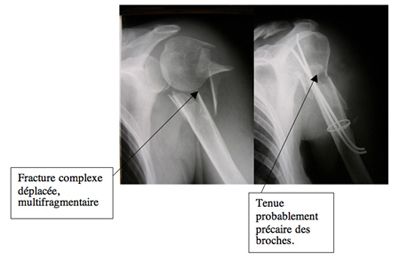
2° PINS AND CIRCLES: The circles can be metallic but they are most often made up of large diameter wires invisible on x-rays.
This type of technique can be used in displaced fractures in the elderly patient, but not too complex because the holding of the wires and pins in the elderly patient depends a lot on the quality of the bone which is sometimes precarious at an advanced age.
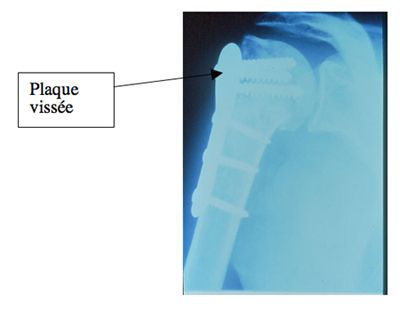
They are mainly used in fractures in young patients. Some recently developed models are more easily used in older patients, but their use must be well codified. Removal of the material is rarely necessary beyond the age of 50; it is desirable before this age.
4° NAILS
These are systems that are placed inside the bone, in association with screws.
They are very useful in elderly patients, because they have better hold than pins and simple circles and do not require an overly extensive surgical approach, unlike plates for example, which require exposing the entire fracture to perform fixation. This advantage makes it possible to reduce damage to the tissue around the bone (the periosteum) created by a direct approach, lesions which can be unfavorable for consolidation.
They are particularly useful in displaced 2-part fractures in elderly patients.
5° CENTROMEDULLARY OSTEOSYNTHESIS SYSTEMS DIFFERENT FROM NAILS
Certain systems allow internal stabilization of fracture fragments and promise the possibility of better bone consolidation, while trying to keep as much bone as possible (Bilboquet implant).
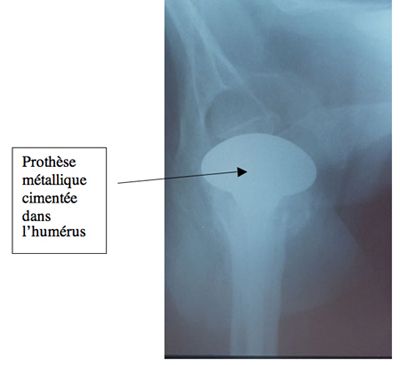
6° LA PROTHESE D’EPAULE POUR FRACTURE dite aussi « PROTHESE HUMERALE SIMPLE »
It remains widely used, particularly in the most complex fractures.
These fractures, like fractures of the upper end of the femur (fracture of the “neck” of the femur), are fragile when trying to keep the entire bone with an osteosynthesis system. For these fractures, there is a risk of secondary displacement and bone necrosis due to disappearance of the vascular supply after the installation of osteosynthesis.
Unlike osteosynthesis systems, the humeral prosthesis does not preserve the bone of the upper end of the humerus, but replaces a large part of it with a metal element (the prosthesis), which is cemented into the humerus.
A few years ago, the results of shoulder prostheses for fractures, good in terms of pain, were insufficient in terms of mobility and strength. The appearance of new prostheses better adapted to the morphology of the humerus and not modeled on prostheses of the upper end of the femur, currently allows us to hope for better results in terms of mobility and strength.
However, whatever the model used, immobilization varies from a few days to 3 weeks, depending on the stability of the surgical setup and rehabilitation is long (6 months, sometimes more).
The result depends a lot on the quality of the bone but above all on the quality of the surgeon, who must be used to this type of fracture (you cannot be used to it if you operate less than 10 per year), in order to best adjust the position of the prosthesis in relation to the bone, a position which determines the good final result.
Can we regain normal function?
This is the goal of all treatment!!
However, it all depends on several factors:
– The complexity of the fracture
– The age of the patient
– The patient's ability to take charge of themselves and to cope with long and sometimes tedious, but totally essential, post-operative rehabilitation.
– The dexterity of the surgeon who must be used to this type of fracture.
The combination of all these favorable factors can make it possible to regain a normal shoulder, that is to say without pain, with mobility comparable to the healthy shoulder and with strength allowing the gestures of daily life, work and leisure.
If only one of these factors is seriously deficient (very complex fracture, very old patient, inability to understand and follow post-operative rehabilitation, “insufficiently trained” surgeon), the shoulder may be painless, but will rarely be normal in terms of mobility and strength.
– The patient's ability to take charge of themselves and to cope with long and sometimes tedious, but totally essential, post-operative rehabilitation. – The dexterity of the surgeon who must be used to this type of fracture.
The combination of all these favorable factors can make it possible to regain a normal shoulder, that is to say without pain, with mobility comparable to the healthy shoulder and with strength allowing the gestures of daily life, work and leisure.
If only one of these factors is seriously deficient (very complex fracture, very old patient, inability to understand and follow post-operative rehabilitation, “insufficiently trained” surgeon), the shoulder may be painless, but will rarely be normal in terms of mobility and strength.
– The patient's ability to take charge of themselves and to cope with long and sometimes tedious, but totally essential, post-operative rehabilitation. – The dexterity of the surgeon who must be used to this type of fracture.
The combination of all these favorable factors can make it possible to regain a normal shoulder, that is to say without pain, with mobility comparable to the healthy shoulder and with strength allowing the gestures of daily life, work and leisure.
If only one of these factors is seriously deficient (very complex fracture, very old patient, inability to understand and follow post-operative rehabilitation, “insufficiently trained” surgeon), the shoulder may be painless, but will rarely be normal in terms of mobility and strength.
In conclusion, these fractures are complex and we can encounter everything, from the very simple fracture which will consolidate in 3 weeks of immobilization, to the most complex fractures which require the installation of a prosthesis and long rehabilitation.
Only your doctor will be able to assess the seriousness of the fracture and direct you towards one or other of the various therapies.