
Lumbar Disc Herniation
Information published by IRCOS about Lumbar Disc Herniation: relevant practitioners, available content and related documents to help you prepare for your consultation.
Most sciatica caused by herniated discs (80%) are cured by medical treatment.
Medical treatment includes relative rest, anti-inflammatories (or even corticosteroids), and analgesics. This medical treatment may take 6 to 8 weeks to be effective.
If this treatment is ineffective, lumbar infiltrations of corticosteroids may be offered.
A surgical procedure called a dissectomy will only be considered:
if medical treatment is insufficient to relieve pain
if there is an emergency situation with risk of irreversible neurological damage: motor deficit (paralyzing sciatica), intolerable pain not relieved by opioids (hyperalgic sciatica), cauda equina syndrome (perineal disorders, sphincter dysfunctions, particularly urinary)
A disc herniation discovered incidentally on the CT scan or MRI and giving no symptoms should not lead to intervention.
The main element leading to proposing surgical intervention, apart from the 3 emergency situations described, is the patient's intolerance to pain.
Objectives of surgery and expected benefits
The goal of the intervention is to release the nerve root compressed by the herniated disc, and to make the sciatica pain disappear. This objective is achieved in approximately 85% of cases.
It is never possible to ensure that sensory or motor disorders will disappear completely: the nerve root may have been compressed for too long and may have been damaged.
The intervention does not restore the disk to new condition. The disc degeneration lesions will persist and a more or less significant part of the lower back pain will persist after the operation.
No intervention restores the body to new condition. No result is ever 100% guaranteed.
Progress of the intervention
The goal of the intervention is to free the nerve root from compression.
It takes place under general anesthesia. The surgeon accesses the spinal canal between 2 vertebrae through a short incision (4 cm), then to the intervertebral disc by reclining the root(s) laterally. He removes the herniated disc and empties the center of the disc, to prevent a free fragment from mobilizing and causing a recurrence of the compression. The disc is never completely removed.
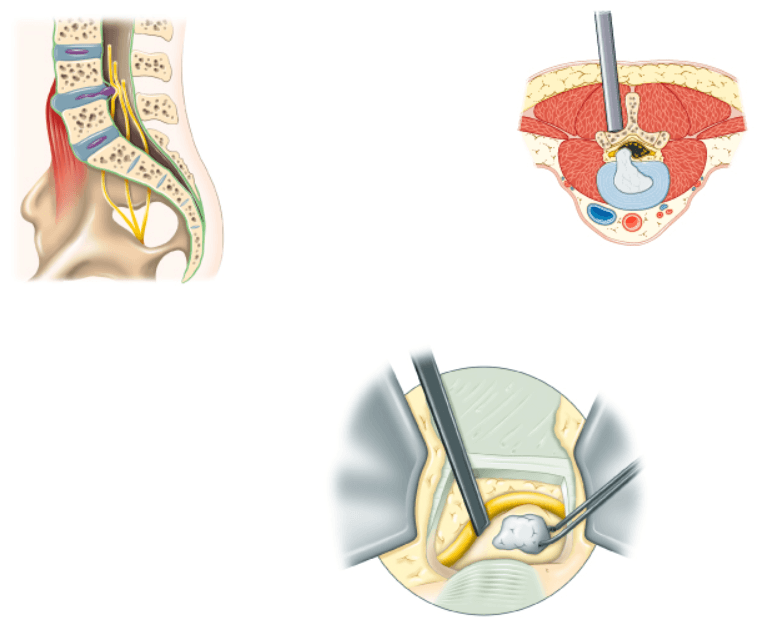
In other cases, the approach may be wider and root release may require an additional release procedure. It is sometimes necessary to remove part of the vertebra (foraminotomy, arthrectomy, laminectomy) to sufficiently free the compressed root(s).
The surgical aftermath
The consequences are not very painful and are well controlled by analgesic treatment.
Sciatica pain disappears either upon waking up or after a few days; paralysis requires at least several days to recover; Sensitivity disorders often take several weeks to resolve. Complete recovery from sensory or motor disorders is never certain.
Getting up is possible in the evening or the day after the operation.
If a drain has been placed, it will be removed two days after the procedure.
Return home is possible 2 days after the operation. Walking is recommended. The car is not recommended for 3 weeks. There is no need to wear a corset. Rehabilitation can be interesting but is not systematic and generally begins 1 month after the operation.
The work stoppage is 2 weeks to 3 months depending on the profession.
What are the possible risks involved?
The risks inherent in any surgical intervention
-The occurrence of phlebitis complicated by pulmonary embolism is possible. In case of favorable conditions, anticoagulant treatment is given.
– Healing disorders are very rare, but may require further intervention.
The risks associated with surgery for lumbar disc herniation
– A hematoma may occur during the procedure. If it is large it can compress the nerves and cause pain, paralysis, sphincter disorders. Reoperation to evacuate the hematoma is necessary.
-Neurological complications may occur: sensory disorders, motor disorders with paralysis, very rare, often of ischemic origin (defect in blood supply). These disorders are most often transient, very rarely permanent.
-A breach in the envelope which surrounds the nerves (meninges) is possible and can cause a leak of the fluid contained in the meninges. It is most often repaired by the surgeon. If the leak persists, it may be necessary to intervene again.
-Surgical site infection is rare (0.1 to 1%). A new intervention for local cleaning is sometimes necessary. Deep infections (Spondylodiscitis = disc infection) are rare. Painful after-effects may persist. Aseptic precautions and antibiotics have significantly reduced the rate of occurrence of these complications.
-A lesion of the large abdominal vessels located in front of the spine can lead to serious hemorrhage and, in extreme cases, death.