
Shoulder Instability
Information published by IRCOS about Shoulder Instability: relevant practitioners, available content and related documents to help you prepare for your consultation.
Shoulder instability can cause several clinical manifestations: repeated dislocations, pain, subdislocations or jerks.
Recurrent dislocation
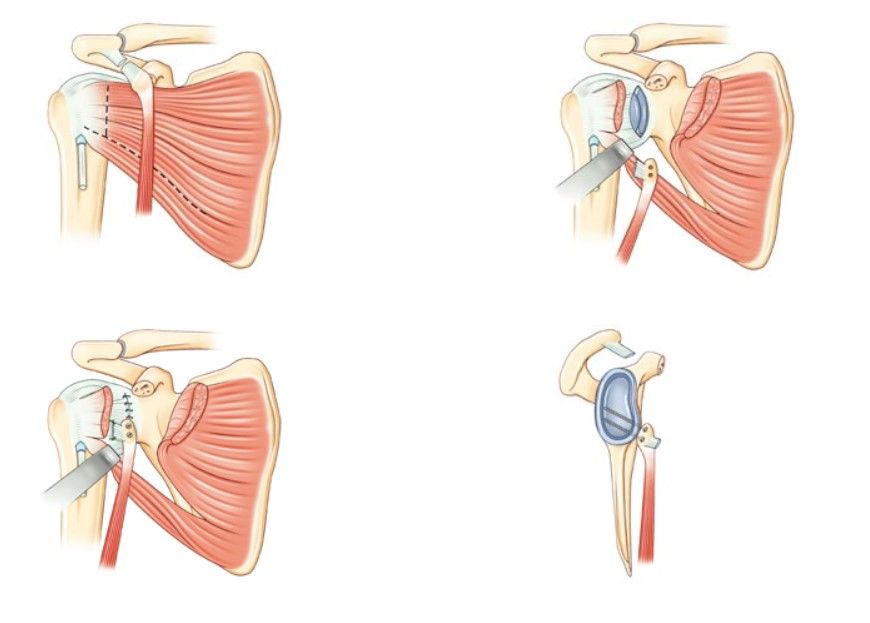
a- The Latarjet technique
This classic method is proven. It regularly gives very good clinical results (around 95%). The principle is to place a bony stop at the place where the humeral head “passes”, this stop being removed through the same incision (see diagram). This procedure requires two to three days of hospitalization, the patient leaves home with the upper limb immobilized by a splint for three weeks, but rehabilitation is undertaken immediately in order to recover all joint mobility as quickly as possible. Resumption of sport is authorized in the third month postoperatively. The patient is seen again in consultation for postoperative follow-up on day 45, then at 3 months and 6 months.
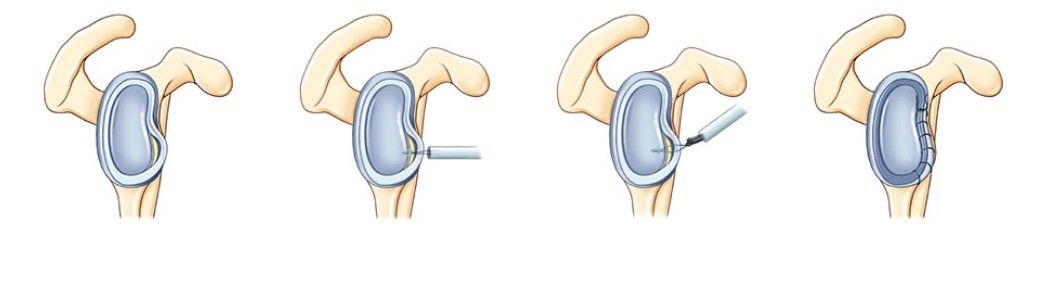
b- Arthroscopic stabilization
Arthroscopic stabilization methods are very recent. The principle is to repair directly intra-articularly the shoulder ligaments which have been torn by dislocations. The approach routes are reduced: a 5 mm entry point on the posterior side of the shoulder and one or two slightly larger anterior entry points. In addition to the aesthetic nature, they have the advantage of not damaging any muscles and therefore allow a more complete recovery. The exploration of the joint is complete and allows the diagnosis to be refined. The ligaments are then attached to the anterior edge of the glenoid by tightening them with anchors. Hospitalization is 48 hours, and immobilization is 45 days with an elbow brace on the body. Resumption of sport is authorized at the 6th month. Post-operative follow-up is the same.
The success rates are still lower than those of traditional techniques, but by refining the indications, they are improving regularly: fewer than 3 dislocations, few bone lesions on the pre-operative x-rays and CT scan.
Painful shoulder
This is anterolateral shoulder pain occurring in young and athletic subjects during arm movements. Patients complain little or not of instability but of pain, and we must therefore know how to think about it. Pre-operative examinations (X-rays and especially CT arthrography) most often confirm the diagnosis.
Here again the only therapeutic possibility is surgical. The techniques used are the same, but these cases are often the most accessible to arthroscopic treatment.
Posterior dislocation
Much rarer, they represent only 5% of shoulder dislocations, and most often occur in specific contexts. The diagnosis is more difficult and often made late. Here again the examinations are mainly simple x-rays and arthrography.
In the event of recurrent dislocation, the only treatment is also surgical: ligament abutment or retensioning by conventional or arthroscopic means.